Conversations give children opportunities to share ideas, learn new words, listen to others and practise taking turns. They also help children explain experiences, ask for clarification, express preferences and advocate for what they need.
This collection includes 100 conversation starters for kids, organized by topic. Some are simple and concrete, while others involve remembering, explaining, imagining or solving a problem.
The categories are a guide, not a test or rigid age system. Choose questions that fit your child’s interests, communication style and current abilities.
Children can respond by:
- Speaking
- Pointing
- Signing
- Gesturing
- Drawing
- Selecting a picture
- Typing
- Using an augmentative and alternative communication system, or AAC
- Showing or demonstrating an answer
A meaningful response does not have to be a complete spoken sentence. The goal is connection and communication, not producing one predetermined answer.
How to Use These Conversation Starters
Start with three or four questions rather than working through an entire section. Use them during a relaxed activity such as eating a snack, drawing, riding in the car, walking, playing or getting ready for bed.
To keep the conversation feeling natural:
- Choose topics your child genuinely enjoys.
- Answer some questions yourself.
- Allow enough time for the child to process and respond.
- Accept different forms of communication.
- Add a relevant comment before asking another question.
- Follow the child’s topic when they introduce something new.
- Stop if the interaction starts to feel like a quiz.
For more practice understanding different question types, explore our guide to 60 WH questions for kids.
Conversation Starters for Preschoolers
These questions focus on familiar people, objects, activities and routines. Younger children may answer by showing, pointing, choosing between options or using a short phrase.
- What is your favorite toy to play with?
- What do you like to do when you go outside?
- Which animal would you like to see today?
- What is your favorite snack?
- Who makes you laugh?
- Where do you like to play?
- What song do you like to sing or listen to?
- What would you build with these blocks?
- Which color would you choose for your picture?
- What do you like to do before bedtime?
- Which book would you like us to read?
- What was something fun you did today?
- How do you help at home?
- What do you like to do when it rains?
- If you could choose our next game, what would we play?
Make These Questions Easier
You can support participation by:
- Showing two toys and asking the child to choose one.
- Using photographs of familiar people or activities.
- Asking the question while the activity is happening.
- Modeling a possible response.
- Giving the child additional time.
- Turning the question into a choice: “Would you build a house or a tower?”
If a child points to the tower instead of saying “tower,” acknowledge the response: “You chose the tower. Let’s build a tall tower.”
Conversation Starters for Elementary-Age Children
These prompts invite children to recall experiences, explain their thinking and contribute more detail. Adjust the language and level of support to fit the individual child.
- What is something interesting you learned this week?
- What part of your day would you like to do again?
- What is something that felt difficult at first but became easier?
- How would you explain your favorite game to someone who has never played it?
- Which character from a book or show would you like to meet?
- What is a fact you know that you think other people would find interesting?
- What do you usually like to do after school?
- What is something you made or completed that made you feel proud?
- If you could become better at one skill, which skill would you choose?
- What is one school rule that helps people?
- What can two people do when they disagree about a game?
- What is something you could teach a younger child?
- What is a question you would like to ask your teacher?
- Which subject could you talk about for five minutes?
- If you could change one part of your daily routine, what would you change?
Encourage More Detail Without Demanding It
Instead of saying “Give me a longer answer,” try a related prompt:
- “What happened next?”
- “What did you like about it?”
- “Who was there?”
- “Can you show me?”
- “What made you choose that?”
- “That reminds me of something. Would you like to hear it?”
A follow-up should show interest rather than communicate that the first answer was inadequate.
Questions About Favorite Things
Topics connected to a child’s interests often make conversation easier and more motivating.
- What is your favorite thing to do on the weekend?
- Which meal or snack do you enjoy most?
- What is your favorite place to visit?
- Which animal do you find most interesting?
- What is your favorite thing to draw or create?
- Which song always makes you want to move or sing?
- What is your favorite thing about your room?
- Which season do you enjoy most, and what do you like about it?
- What is your favorite game to play with another person?
- Which book, show or movie would you recommend to someone else?
- What is your favorite way to spend time outside?
- Which holiday or family tradition do you enjoy?
- What is your favorite thing to learn about?
- Which sound do you enjoy hearing?
- What activity makes time seem to pass quickly?
Turn an Answer Into a Conversation
If a child says, “Dinosaurs,” the adult might respond:
“You really like dinosaurs. I think a triceratops looks interesting because of its horns. Which dinosaur would you choose?”
This approach:
- Acknowledges the child’s answer.
- Adds related information.
- Gives the child something specific to respond to.
The conversation becomes an exchange rather than a sequence of questions.
Questions About Family and Friendships
Families, friendships and social relationships can look different for every child. Use inclusive language and avoid assuming that all children have the same family structure, friendships or living arrangements.
- What is something you enjoy doing with your family or caregivers?
- Who is someone you feel comfortable talking to?
- What makes someone a good friend?
- What is something kind someone has done for you?
- What is one kind thing you could do for another person?
- What do you like to play or talk about with friends?
- How can you invite someone to join an activity?
- What could you say if you wanted a turn?
- What can you do if someone does not want to play the same game?
- How can you tell someone that you need space?
- What is something another person knows that you would like them to teach you?
- How can you show someone that you are listening?
- What could you do if you accidentally hurt someone’s feelings?
- Who could you talk to if you had a problem?
- What is something that makes you feel included?
Allow Different Perspectives
Questions about friendship do not always have one correct answer. One child may enjoy large groups, while another may prefer one familiar person or more time alone.
Do not require a child to identify a “best friend,” enjoy group activities or communicate in one socially preferred way. Focus on whether the child can communicate safely and effectively in the relationships and situations that matter to them.
School Conversation Starters
These questions can help children talk about learning, classroom routines and school experiences without relying on the very broad question, “How was school?”
- What was the most interesting part of school today?
- What made you laugh or smile?
- What was something you already knew how to do?
- What was something new or unfamiliar?
- Which activity required the most thinking?
- What is one thing you would like more help with?
- What happened before lunch or recess?
- Did you hear a word today that you would like to understand better?
- What was one choice you made today?
- What is something you would like your teacher to know?
- If you could add one activity to the school day, what would you add?
- What is one thing that could make tomorrow easier?
Replace “How Was School?”
“How was school?” can be difficult because it is broad and may require a child to review several hours of experiences at once.
More specific prompts reduce the amount of information the child has to organize:
- “What did you do after lunch?”
- “Who sat near you?”
- “Which activity did you choose?”
- “Was anything different today?”
- “What should we remember for tomorrow?”
A visual schedule, teacher note, photograph or school calendar may provide useful context.
Questions About Feelings and Self-Advocacy
These prompts can help children identify preferences, describe internal experiences and communicate what might help. Do not insist that a child assign one emotion to an ambiguous experience.
- What is something that helps you feel calm?
- How can your body tell you that you are getting tired?
- What does excitement feel like for you?
- What can you say when you do not understand?
- How can you ask someone to repeat what they said?
- What could you say if you need more time?
- How can you let someone know that a sound is too loud?
- What helps when a place feels too busy?
- What is something you can do when you feel frustrated?
- Who can you ask for help?
- What could you say if you do not want to be touched?
- How can you tell someone that you have changed your mind?
- What makes it easier for you to join an activity?
- What is something you wish other people understood about you?
Model Useful Self-Advocacy Language
Depending on the child’s communication method, useful messages might include:
- “I need help.”
- “I don’t understand.”
- “Please say it again.”
- “I need more time.”
- “Not right now.”
- “I need a break.”
- “That is too loud.”
- “Please stop.”
- “Can I do it another way?”
- “I want to use my device.”
A child can communicate these messages through speech, sign, gesture, a picture, a written message or AAC.
Imagination and Problem-Solving Questions
These prompts involve prediction, flexible thinking and explaining possible solutions. Several different answers may be reasonable.
- If you could design a new playground, what would you include?
- What would you do if you found a tiny door in your bedroom wall?
- If animals could talk, which animal would have the funniest things to say?
- How could you carry five toys without dropping them?
- What could you do if the game pieces were missing?
- If you could invent something to help people, what would it do?
- What would happen if it rained bubbles instead of water?
- How could two people share one art set?
- What could a character do if they became lost?
- If you could create a new school subject, what would students learn?
- What are three different ways to build a shelter for a toy?
- What could you do if your first idea did not work?
- If you could change the ending of a familiar story, what would happen?
- What is a problem you would like to solve, and what might your first step be?
Ask How the Child Reached Their Answer
For older children or those ready for a greater challenge, add:
- “What made you think that?”
- “What clue helped you?”
- “Could there be another answer?”
- “What might happen after that?”
- “What would you try first?”
- “How would that affect another person?”
Accept creative, unexpected answers when the child can explain the connection.
How to Support a Child Who Gives One-Word Answers
A one-word answer is still communication. It may reflect the child’s language skills, processing time, interest, comfort, energy, communication style or the type of question being asked.
The following strategies can make conversation easier.
1. Comment Before Asking Another Question
Instead of immediately asking, “Why do you like trains?”, try:
“Trains can go through cities, mountains and tunnels. I like watching them go over bridges.”
The child now has information to respond to without being placed under immediate pressure.
2. Use a Balanced Question-to-Comment Ratio
A rapid series of questions can feel like an interview. Mix questions with:
- Observations
- Personal experiences
- Relevant facts
- Humor
- Demonstrations
- Pauses
3. Offer Meaningful Choices
Instead of “What did you like about the movie?”, try:
“Did you like the music, the characters or something else?”
Choices can support understanding without restricting the child to a single spoken response.
4. Model an Answer
Take your own turn first:
“Something that helped me today was making a list. What helped you?”
This demonstrates the type of information the question is requesting.
5. Expand Rather Than Correct
If the child says, “Dog,” the adult might respond:
“The big dog was your favorite.”
There is no need to require the child to repeat the expanded sentence.
6. Follow the Child’s Interests
Conversation usually becomes easier when the topic matters to the child. A detailed conversation about elevators, sea animals, maps or a favorite game is still valuable communication practice.
7. Give Processing Time
Ask the question, pause and remain available. Repeating or rewording too quickly can interrupt the child’s processing.
8. Use Visual Supports
Photographs, drawings, objects, calendars, emotion symbols and visual schedules can make an abstract question more concrete.
9. Make AAC Available
If the child uses AAC, their communication system should be available throughout the conversation. Do not require a spoken answer before accepting an AAC response.
10. Respect the Decision Not to Talk
Children do not need to answer every question. They may communicate “I don’t know,” “not now,” “different question” or “I don’t want to talk about that.”
What Meaningful Conversation Can Look Like
Conversation is more than answering questions. It may involve:
- Starting an interaction
- Responding to another person
- Adding a relevant comment
- Asking a question
- Sharing an experience
- Taking communication turns
- Changing or returning to a topic
- Clarifying a message
- Repairing a misunderstanding
- Telling another person what support is needed
- Ending an interaction
Children develop these skills at different rates and may use them differently across people, places and situations.
The American Speech-Language-Hearing Association explains that social communication includes using language for different purposes, adapting communication to the situation and participating in conversations and storytelling. Learn more through ASHA’s social communication resource.
Using Conversation Starters With Multilingual Children
Use the language or languages in which you and your child feel most comfortable communicating.
A child may know a word, story or idea in one language before being able to express it in another. Families do not need to stop using their home language to practise communication skills.
You can:
- Ask and answer questions in your home language.
- Accept responses that combine languages.
- Discuss the same topic with different family members.
- Read and tell stories in the languages your family uses.
- Share relevant language information with the child’s speech-language pathologist.
Multilingualism does not cause a speech or language disorder. If a genuine communication difficulty is present, it should be considered across the child’s languages and communication environments.
When Conversation Difficulties May Need Professional Support
Conversation starters are practice tools, not diagnostic tests. A child’s responses to this list cannot determine whether they have a communication disorder.
Consider discussing your concerns with a pediatrician, audiologist or speech-language pathologist if your child:
- Rarely initiates or responds to communication
- Has difficulty understanding familiar questions
- Frequently appears unsure what type of information a question requests
- Has persistent difficulty following developmentally appropriate directions
- Becomes regularly frustrated when trying to communicate
- Has difficulty telling you about recent events
- Has trouble making their message understood
- Cannot easily repair a misunderstanding
- Experiences speech that is difficult for familiar or unfamiliar listeners to understand
- Shows tension, struggle or avoidance when speaking
- Loses communication skills they previously used
- Has communication difficulties that affect participation at home, at school or with other people
- Has received communication-related concerns from a teacher, pediatrician or another professional
Hearing can also affect speech and language development. A hearing evaluation may be recommended when a child has difficulty consistently hearing, understanding or responding to spoken language.
ASHA provides communication milestones by age range to help families understand general developmental expectations. Milestones are guides rather than diagnostic checklists.
Looking for Pediatric Speech Therapy in New Jersey?
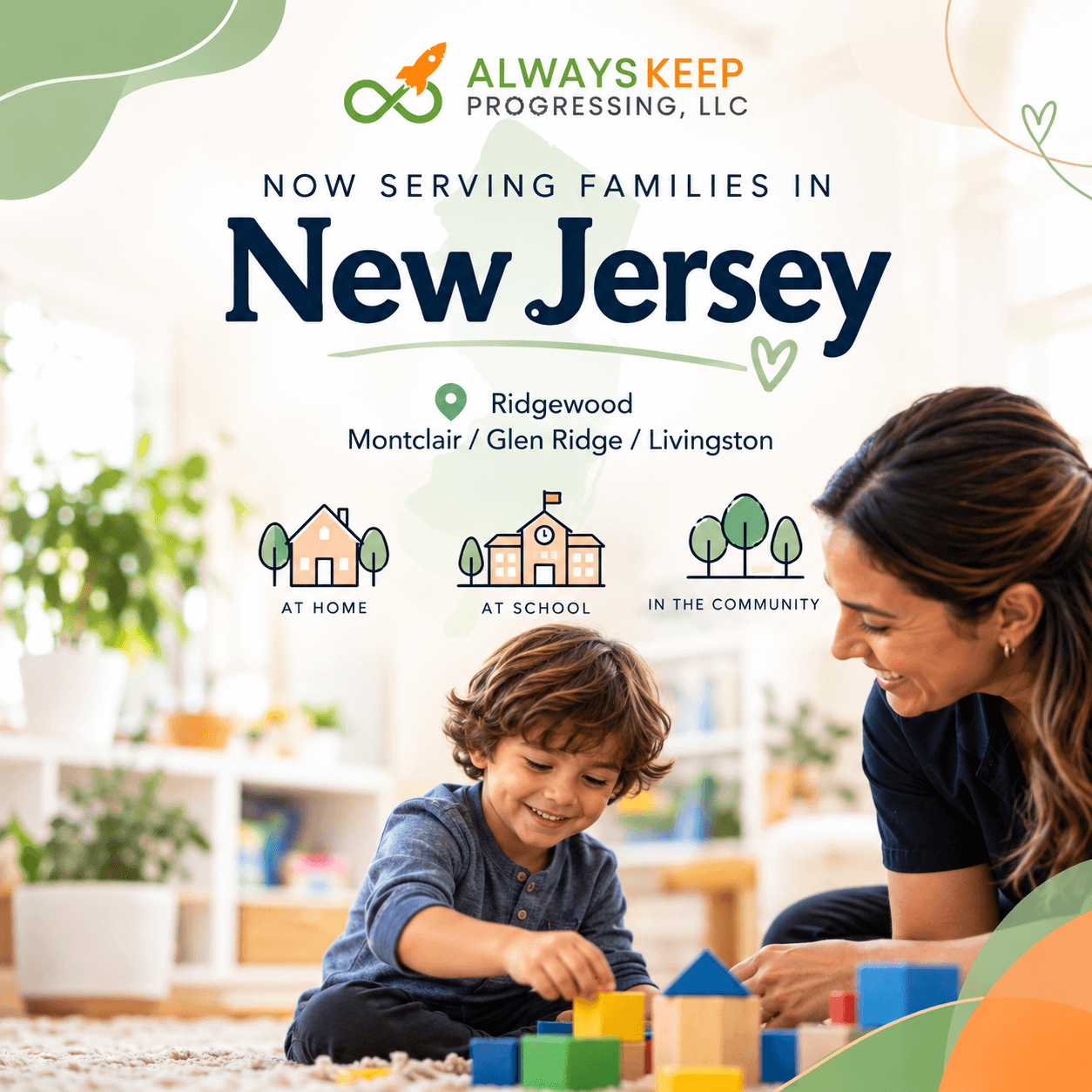
Always Keep Progressing provides pediatric speech therapy for children and families in Ridgewood, Montclair, Glen Ridge, Livingston and surrounding Northern New Jersey communities.
Depending on clinical recommendations, insurance requirements and provider availability, services may be delivered:
- At home
- At school or daycare, with appropriate permission
- In community settings
- Through teletherapy when appropriate
Our speech-language pathologists develop individualized goals around each child’s communication strengths, needs and everyday environments.
Explore pediatric speech therapy in New Jersey
View all New Jersey pediatric therapy services
Speech Therapy for Miami Families
AKP also provides pediatric speech therapy through our multidisciplinary Miami center. Families can access speech-language services alongside ABA, occupational therapy, feeding therapy, music therapy and other developmental services when clinically appropriate.
Explore speech therapy in Miami
View pediatric therapy services in Miami
Conversation Starters for Kids: Frequently Asked Questions
What are good conversation starters for kids?
Good conversation starters are understandable, relevant and interesting to the individual child. Questions about favorite activities, recent experiences, familiar people and imaginative situations are often more engaging than broad prompts such as “What did you do today?”
At what age can I use conversation starters?
Conversation begins before children speak in full sentences. Young children can participate by pointing, gesturing, selecting a picture, using one word, signing or using AAC. Choose prompts that match the child’s understanding and communication abilities rather than relying only on chronological age.
How many questions should I ask at once?
A few questions are usually enough. Start with three to five prompts during a relaxed activity and allow the conversation to move naturally. There is no benefit to completing all 100 questions in one sitting.
What if my child says “I don’t know” to every question?
Try making the question more concrete, providing a choice, using a visual or answering first. The child may need additional processing time or may not be interested in the topic. “I don’t know” can also be an appropriate and meaningful response.
Should I correct my child’s grammar or speech sounds?
Avoid interrupting the child’s message to require a correction. You can naturally model the word or sentence correctly in your response. If you have concerns about persistent speech or language difficulties, seek guidance from a speech-language pathologist.
Can autistic children use these conversation starters?
Yes, when the prompts are adapted around the individual child’s interests, communication method and support needs. Do not require eye contact, spoken language or conversation about topics the child finds distressing. AAC, scripts, gestures and other communication methods should be respected.
Can conversation starters help a child who uses AAC?
Yes. Questions can provide opportunities to locate vocabulary, combine messages, comment, ask questions and share opinions using AAC. The child’s system should remain available, and adults should avoid turning every interaction into a test of device use.
Should bilingual families practise in English?
Families should communicate in the language or languages they use most comfortably. Rich, natural interaction in a home language supports connection and language development. A bilingual child does not need to abandon one language to develop another.
Are conversation difficulties always a sign that a child needs speech therapy?
No. Children differ in temperament, interests, communication style and development. Professional support may be helpful when communication difficulties are persistent, cause frustration or interfere with participation in everyday activities.
Keep the Conversation Going
The best conversation starter is not necessarily the most clever question. It is one that helps a child communicate something meaningful and shows them that another person is interested in their response.
Choose a few prompts, follow the child’s lead and leave room for comments, questions, silence, humor and unexpected answers.
If you have concerns about your child’s speech, language or social communication, Always Keep Progressing can help you understand the available evaluation and therapy options.
Contact Always Keep Progressing