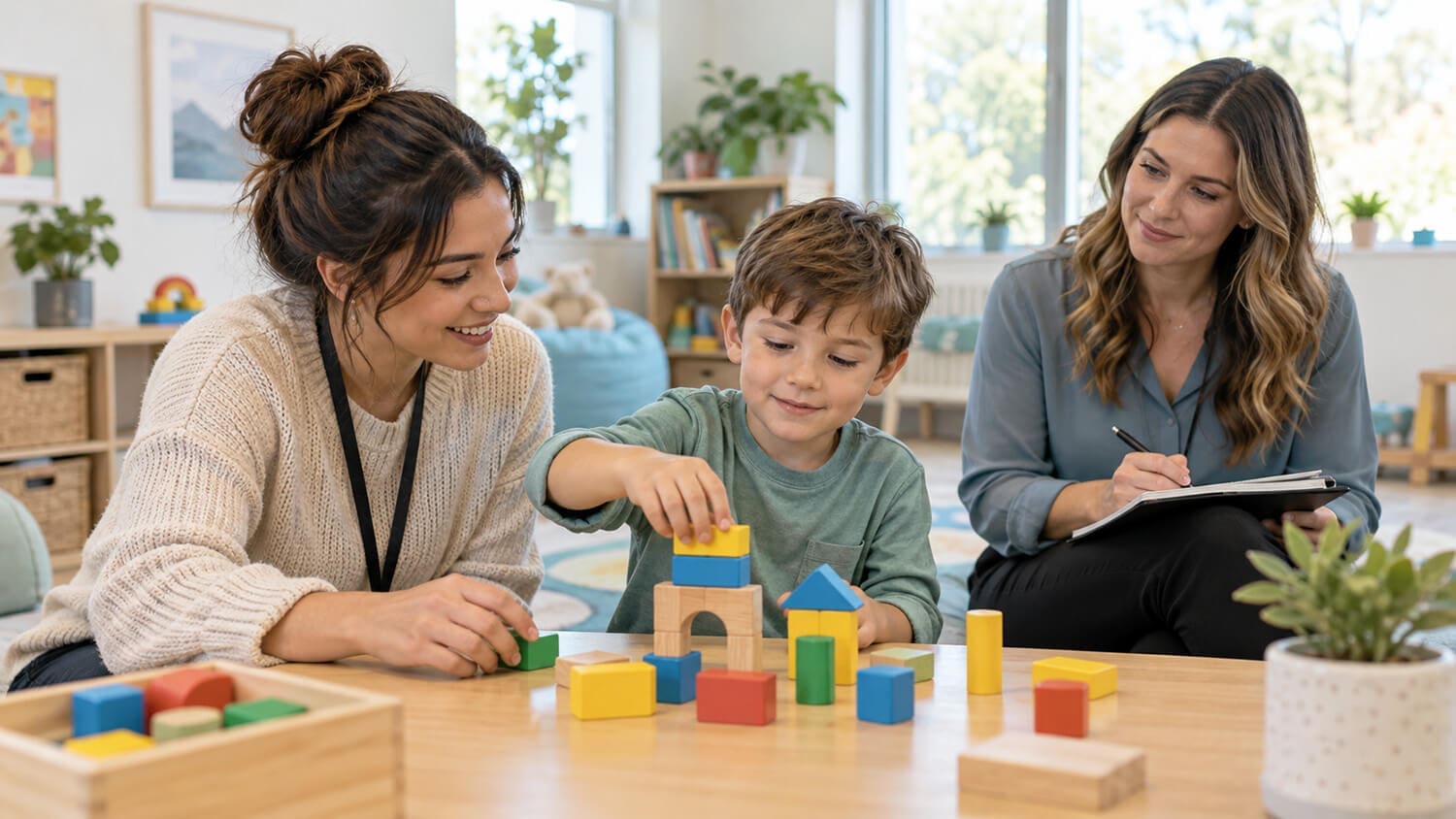
WH questions ask for specific kinds of information. They include who, what, where, when, why, which, whose and how. Children use these questions to learn about the world, participate in conversations, explain experiences and find information they need.
Questions such as “What is she holding?” or “Where is your cup?” may sound simple, but answering them involves several connected language skills. A child must:
- Recognize what kind of information the question requests.
- Understand the vocabulary and grammar used in the question.
- Find the answer in front of them or retrieve it from memory.
- Organize an appropriate response.
- Communicate that response through speech, gesture, sign, pointing or an augmentative and alternative communication (AAC) system.
For example, answering “Who is running?” requires the child to understand that who asks about a person. Answering “Why is the child running?” adds another layer: the child may need to examine the situation, identify a possible cause and explain their reasoning. Although both questions refer to the same action, they place very different demands on language and thinking.
Children generally understand concrete questions about visible, familiar information before questions involving past events, time concepts, sequencing, reasoning or inference. However, WH-question development does not follow one rigid sequence. A child may answer familiar “why” questions while still finding some complex “what” questions difficult. Performance can also change depending on the setting, vocabulary, visual support, familiarity of the subject and time available to respond.
A child does not have to answer with spoken words to demonstrate understanding. Pointing to a person, selecting a picture, signing, gesturing or responding with AAC may all provide a meaningful answer.
Quick answer: Children often begin responding to simple what and where questions during the toddler years. Who, when, why and how questions generally become more consistent as vocabulary, grammar, memory and reasoning develop. These are approximate developmental patterns—not pass-or-fail deadlines.
In this guide, we will explain how different WH questions work, when these skills commonly emerge, why some questions are harder than others and how parents can support development through everyday conversation, play and shared reading.
Also see: 60 WH Questions For Kid - Explore 60 WH questions for kids, organized by question type and difficulty, with simple tips for practising during play, reading and daily routines.
What Are WH Questions?
WH questions are information-seeking questions that ask for more than a simple yes or no response. Each question word requests a particular kind of information, such as a person, object, place, time or reason.
The most familiar WH questions begin with who, what, where, when and why, but the group also includes which and whose. Although how does not begin with the letters wh, it is conventionally included because it also asks someone to provide specific information.
| Question word | Asks about | Simple example | Expected answer |
|---|---|---|---|
| Who | A person or people | Who is driving? | A person |
| What | A thing, action or idea | What is she eating? | An object or action |
| Where | A place or position | Where is your backpack? | A location |
| When | A time, sequence or event | When do we eat breakfast? | A time or occasion |
| Why | A reason or cause | Why is he wearing a coat? | A reason |
| How | A method, condition or explanation | How do you open the box? | A process or description |
| Which | A selection | Which cup is yours? | One of several choices |
| Whose | Ownership | Whose shoes are these? | A person or owner |
Understanding the question word helps a child determine what kind of answer to provide. For example, compare these questions about the same familiar event:
- What did you eat for breakfast?
A bowl of cereal. - Where did you eat breakfast?
At the kitchen table. - Who ate breakfast with you?
My sister. - When did you eat breakfast?
This morning. - Why did you eat breakfast?
Because I was hungry. - How did you make breakfast?
I poured cereal and milk into a bowl.
The topic remains breakfast, but every question requires a different category of information. A child may remember the event clearly and still provide an unexpected answer if they do not understand what the question word is asking.
For example, if asked, “Where did you eat breakfast?” a child might answer “cereal.” That response shows knowledge of the event, but it answers what rather than where. The difficulty may involve understanding the question word—not remembering breakfast or knowing the word cereal.
WH questions also vary in complexity within the same category. “Where is your cup?” may be answered by looking or pointing when the cup is visible. “Where did we put your cup after lunch yesterday?” requires the child to understand the same question word while also recalling a past event. For that reason, successfully answering one type of where, what or why question does not necessarily mean that every question beginning with that word will be equally easy.
Why Are WH Questions Important for Children?
WH questions are part of everyday communication. Children use them to find missing information, express what they need, understand what is happening and share their experiences with other people. They also encounter these questions during family routines, play, stories, classroom activities and conversations with friends.
The goal is not simply to teach children to provide a memorized answer to a set of flashcards. A child needs to understand and use WH questions across different people, places and situations. Knowing that “where” asks about a place, for example, can help a child ask where a missing toy is, follow a conversation about an upcoming trip or explain where something happened.
Asking and answering WH questions can support children in several areas.
Finding information and expressing needs
Children can use questions to request information they need:
- “Where is my water bottle?”
- “Who is picking me up?”
- “When are we leaving?”
- “How do I turn this on?”
This allows the child to take a more active role in daily routines rather than waiting for another person to anticipate every need.
Participating in conversations
Conversations often involve exchanging questions and answers. A child might ask a friend what they are playing, answer a caregiver’s question about school or explain why something made them happy.
These exchanges can support back-and-forth interaction, but successful conversation involves more than answering correctly. Children also need opportunities to comment, initiate, change the subject and communicate in ways that feel comfortable to them.
Understanding and following instructions
WH questions can help children identify important details within directions and routines. They may need to understand:
- What they are expected to do.
- Where an activity will happen.
- Who will be involved.
- When it will begin.
- How to complete it.
The ability to ask for clarification—such as “Where do I put this?”—can be just as important as answering a question.
Sharing and retelling experiences
Questions provide a structure for talking about past events:
- Who was there?
- What happened?
- Where did it happen?
- When did it happen?
- Why did it happen?
- How did it end?
These prompts can help a child organize information when telling someone about a birthday party, a school activity or something that happened during the day.
Understanding stories and classroom information
Teachers frequently use WH questions to check comprehension, encourage discussion and help children think beyond literal facts. A child may be asked:
- “Who is the main character?”
- “Where does the story take place?”
- “What happened first?”
- “Why did the character make that choice?”
- “What might happen next?”
These questions progress from locating stated information to sequencing events, explaining causes and making inferences. A child may understand simple factual questions but need support with questions that require reasoning or information that is not directly stated.
Problem-solving and understanding consequences
Why and how questions can help children consider causes, possible solutions and what may happen next:
- “Why did the tower fall?”
- “How can we fix it?”
- “What might happen if we add another block?”
- “Which piece would work better?”
These questions encourage children to connect events and explain their thinking. The objective is not always one predetermined answer; some situations allow several reasonable responses.
Social interaction
Questions can help children learn about other people’s experiences, preferences and ideas. Examples include:
- “What game do you want to play?”
- “Who is your favorite character?”
- “Why are you laughing?”
- “How did you make that?”
Not every child communicates socially in the same way, and asking frequent questions is not the only sign of interest or connection. WH-question skills are one useful part of a much broader communication profile.
Personal safety
Understanding and using WH questions may also help a child communicate important information. Depending on their age and communication level, a child may need to answer questions such as:
- “Who are you with?”
- “Where does it hurt?”
- “What happened?”
- “Where do you live?”
- “Who can help you?”
Children may also need to ask questions when they are uncertain, lost or need assistance. Safety-related information should be taught in ways appropriate to the individual child, without relying solely on memorized responses.
| Everyday situation | WH-question skill |
|---|---|
| A child cannot find a toy | “Where is my truck?” |
| A caregiver asks about school | “Who did you play with?” |
| A teacher checks comprehension | “Why did the character leave?” |
| A child needs help with an object | “How do I open this?” |
| A family discusses a routine | “When do we brush our teeth?” |
| A child wants to join an activity | “What are you playing?” |
| Someone needs to understand an incident | “What happened?” |
| A child receives an unfamiliar instruction | “Where should I put this?” |
Developing WH-question skills can make it easier for a child to access information and participate in everyday communication. However, these skills do not guarantee academic achievement, independence or social success. They develop alongside vocabulary, grammar, memory, reasoning, attention and social communication, and every child brings a different combination of strengths and support needs.
When Do Children Learn to Ask and Answer WH Questions?
WH-question development varies between children. Age ranges are approximate, skills overlap, and performance changes according to the context and complexity of the question.
Children begin developing the foundations for WH questions before they can ask or answer them with complete sentences. A toddler might look toward the bedroom when asked, “Where is your blanket?” or point to a dog when asked, “What is that?” These nonverbal responses can demonstrate that the child understands the question even if they do not yet say the answer.
As vocabulary, grammar and thinking skills develop, children generally begin asking more questions and providing more detailed answers. However, WH-question development is not a simple checklist in which one question word must be mastered before the next can appear.
The American Speech-Language-Hearing Association notes that children between 13 and 18 months may look around in response to familiar “where” questions. The CDC includes pointing to an item in a book when asked a “where” question among its milestones by age 2, and asking who, what, where or why questions among its milestones by age 3.
By age 5, children may answer simple questions about a story and tell stories containing multiple events. These broader communication milestones help illustrate how answering questions gradually progresses from immediate, visible information toward recall, sequencing and comprehension. ASHA communication milestones, CDC milestones by age 2, CDC milestones by age 3, CDC milestones by age 5
| Approximate stage | Answering questions | Asking questions |
|---|---|---|
| Around 1–2 years | May look, point, select or respond to simple where and what questions about familiar people, objects and routines | May ask early questions such as “What’s that?” using words, sounds, gestures, facial expressions or rising intonation |
| Around 2–3 years | May answer simple what, where, who and what-doing questions in familiar contexts, particularly when the answer is visible or part of a known routine | May ask basic what and where questions and begin using short why questions |
| Around 3–4 years | May answer a broader range of who, what, where and simple why questions about familiar experiences, pictures and stories | May ask increasingly varied questions using who, what, where, why and how |
| Around 4–5 years | May answer when, why and how questions involving basic sequences, causes, predictions and explanations | Questions generally become more grammatically complete, detailed and specific to the situation |
| School age | Develops more advanced answers involving stories, past events, explanations, prediction, inference and different perspectives | Uses questions to clarify instructions, gather information, solve problems, learn about other people and maintain conversations |
These stages describe broad developmental patterns, not firm deadlines. The table should be reviewed by an appropriately qualified speech-language pathologist before publication and considered alongside current communication milestones rather than used as a diagnostic test.
WH-question development does not follow a perfect sequence
Children do not need to master one question word completely before hearing or beginning to use another. Adults naturally use different questions throughout the day, and children learn from that varied language.
A child might ask “Why?” frequently but still struggle to answer a question such as “Why did the character hide?” Asking a familiar one-word question and explaining an unstated character motivation require very different language and reasoning skills.
Similarly, a simple why question can be easier than a complex what question:
- Simpler why question: “Why are you wearing a coat?” when the child is standing outside in cold weather.
- More complex what question: “What did your teacher say we need to bring after lunch tomorrow?”
The second question begins with what, but it requires the child to process a longer sentence, remember previously heard information and understand a future sequence.
Asking and answering may develop at different rates
Recognizing that information is missing and asking an appropriate question is different from understanding and answering someone else’s question. A child may:
- Ask many questions but find it difficult to answer questions about a story.
- Answer familiar questions but rarely initiate questions.
- Use a memorized question such as “What’s that?” in many situations.
- Understand a question but need help organizing the response.
- Know the answer but have difficulty retrieving or producing the words.
For this reason, parents and clinicians should consider asking, understanding and answering as related but distinct parts of communication.
Familiar questions are often easier
Children may answer questions more successfully when the topic, vocabulary and routine are familiar. For example:
- “Where are your shoes?” during the usual morning routine may be relatively easy.
- “Where did the character travel after leaving the castle?” in an unfamiliar story may be much harder.
The second question adds demands involving listening, memory, story comprehension and sequencing. A child’s response can therefore tell us as much about the task as it does about their understanding of the word where.
Skills can look different across settings
A child may answer questions confidently at home but provide fewer responses at school, during an evaluation or around unfamiliar people. Differences can relate to:
- Familiarity with the person or setting.
- Background noise and competing distractions.
- Anxiety or pressure.
- Vocabulary used in the question.
- Visual support.
- Processing time.
- Interest in the topic.
- How the question is presented.
- Access to the child’s usual communication system.
Observations from caregivers, teachers and therapists can therefore provide a fuller picture than performance in one setting alone.
Multilingual children should be considered across all their languages
A multilingual child’s communication skills should not be judged from English performance alone. They may understand or use certain question forms more successfully in one language, with particular people or in familiar cultural contexts.
Differences between languages also matter. Question vocabulary, grammar and word order are not identical across languages. A complete speech-language evaluation should consider the child’s exposure to and use of every language rather than treating a difference from English as evidence of a disorder.
Spoken answers are not the only valid answers
A child may demonstrate understanding by:
- Looking toward the correct person or place.
- Pointing.
- Selecting a photograph or symbol.
- Signing.
- Gesturing.
- Typing or writing.
- Responding through an AAC system.
- Using a combination of communication methods.
For example, a child who selects a picture of the playground when asked, “Where did you go?” has answered the question meaningfully even without producing the spoken word playground.
Development should therefore be considered in relation to the child’s whole communication system—not only the number of answers they can say aloud.
Remember: Age guidance is most useful for noticing broad patterns over time. One missed estimate, one difficult question type or one quiet interaction does not establish a speech or language disorder. If concerns are persistent, occur across situations or form part of a broader communication difficulty, a speech-language pathologist can evaluate the skills involved.
How Speech Therapy Can Help With WH Questions
Difficulty answering WH questions does not always have the same cause. A child may misunderstand the question word, have trouble following the sentence, know the answer but struggle to retrieve it, or need support organizing and communicating a response. Some children answer successfully when looking at a picture but find questions about past events, stories or implied information more difficult.
A speech-language pathologist (SLP) can evaluate the language and communication skills involved to identify where the difficulty is occurring. Depending on the child, the SLP may examine:
- Understanding of question words such as who, what, where, when, why and how
- Receptive vocabulary, or the words the child understands
- Comprehension of sentences and grammatical structures
- Expressive vocabulary and grammar
- Word retrieval
- Recall and sequencing
- Story comprehension and narrative skills
- Prediction, inference and reasoning
- Social communication
- Speech production
- Access to and use of augmentative and alternative communication (AAC)
- Communication across languages, people and settings
For multilingual children, assessment should consider all the languages they use. Differences associated with learning more than one language should not automatically be treated as a disorder. An SLP may gather information from caregivers, teachers and other people who know the child to understand how communication changes across home, school and other environments.
The goal is not simply to count how many questions a child answers correctly. The SLP looks for patterns: Which questions are easier? What kind of support helps? Can the child demonstrate the answer by speaking, pointing, signing, selecting a picture or using AAC? Does performance change when the information is visible, remembered or inferred?
What Therapy May Involve
Speech therapy is individualized according to the skills identified during the evaluation. Depending on the child’s needs, therapy may include:
- Explicitly teaching what different question words mean
- Making the expected answer category visible—for example, pairing who with a person symbol and where with a place symbol
- Using pictures, written words, objects, gestures or other visual supports
- Modeling an appropriate response without demanding immediate repetition
- Recasting the child’s response into a clearer or more complete form
- Practising questions during structured activities
- Embedding practice in play and familiar routines
- Asking and answering questions during shared reading
- Developing story comprehension, retelling and narrative organization
- Reversing roles so the child also practises asking questions
- Supporting responses through AAC
- Coaching caregivers to use helpful strategies during everyday interactions
- Coordinating with teachers or other clinicians when appropriate
- Gradually practising across different people, activities and environments
For example, a child who confuses who and where may benefit from visual answer categories and practice matching questions with people or places. A child who understands the question but cannot readily retrieve the word may need vocabulary and word-finding support. A child who answers questions about visible pictures but struggles with stories may benefit from work on sequencing, recall and inference.
Effective treatment targets the underlying barrier rather than drilling increasingly long lists of questions. Repetition may help build familiarity, but memorizing scripted answers does not necessarily mean a child understands the question or can use the skill in everyday communication. Therapy should help the child apply the concept flexibly, communicate through their preferred method and participate more successfully in situations that matter to them.
At Always Keep Progressing, pediatric speech therapy is based on each child’s communication profile, daily needs and preferred ways of participating. Families are included in the process so that useful strategies can carry into conversations, play, reading and routines outside the therapy room.
Frequently Asked Questions About WH Questions
What does WH mean in WH questions?
“WH questions” is a general term for questions that request specific information rather than a yes-or-no response. They include who, what, where, when, why, which and whose. How is also included even though it does not begin with “wh.” Each question word signals the kind of information needed, such as a person, place, reason, time or method.
Is “how” a WH question?
Yes. Although how does not begin with the letters “wh,” it is conventionally grouped with WH questions because it serves the same information-seeking function. How questions may ask about a method, condition, amount or explanation, as in “How do we make it?”, “How are you feeling?” or “How many do you need?”
Which WH questions do children usually understand first?
Children often begin responding to simple what and where questions about familiar, visible information during the toddler years. For example, identifying an object or looking toward a requested location may be easier than explaining a reason. Development is flexible, however, and difficulty depends on the vocabulary, grammar, context and thinking required—not only the question word.
At what age should a child answer why questions?
Many children begin answering some simple why questions during the preschool years, but there is no single deadline. “Why is she wet?” while watching someone stand in the rain is easier than explaining a character’s hidden motivation. The ability to answer develops as vocabulary, memory, knowledge, causal reasoning and inference grow. Consider the question’s complexity as well as the child’s age.
Why does my child repeat my question instead of answering?
A child may repeat a question while processing its language, using echolalia, requesting a model or trying to continue the interaction. They may also be unsure what kind of answer is expected or feel pressured to respond. Try shortening the question, pausing, modeling an answer or offering visual choices. Repetition alone does not identify a particular condition or diagnosis.
Why can my child answer flashcards but not questions in conversation?
Flashcards provide predictable wording, familiar pictures and a limited set of expected answers. Conversation changes quickly and may require listening, remembering context, retrieving words and interpreting another person’s meaning simultaneously. A memorized response may therefore not transfer automatically. Practising the same concept with different people, materials, routines and settings can help build more flexible understanding.
Should I correct my child’s grammar when they answer?
First acknowledge the meaning of the response. If your child says “boy run,” you might reply, “Yes, the boy is running,” naturally modeling a fuller sentence without turning every interaction into a correction. Whether grammar should be targeted directly depends on the activity and the child’s goals. An accurate idea communicated through speech, gesture, sign or AAC remains meaningful.
Does pointing count as answering a WH question?
Yes. Pointing can demonstrate that a child understood the question, particularly when the answer is visible or choices are available. Looking, gesturing, signing, selecting a picture and using AAC may also be valid responses. The appropriate expectation depends on what is being assessed: understanding the question, finding the information, constructing a sentence or using a particular communication method.
Can a child answer WH questions using AAC?
Yes. Augmentative and alternative communication is a valid way to ask and answer questions. A child may select a symbol, type a message, use a speech-generating device or combine AAC with speech and gestures. The system should provide access to the vocabulary needed for different answer categories, including people, places, actions, times, feelings, reasons and descriptive words.
Are WH-question difficulties a sign of autism?
Difficulty with WH questions can occur in autistic and non-autistic children and is not diagnostic by itself. Possible factors include language comprehension, vocabulary, attention, memory, word retrieval, anxiety, unfamiliar context or the reasoning required by the question. If difficulties are persistent or affecting everyday communication, a speech-language evaluation can help identify the child’s strengths and specific support needs.
How many WH questions should we practise at once?
There is no ideal number. A few meaningful questions during play, reading or a familiar routine may be more useful than a long drill. Begin where the child can participate successfully, allow processing time and stop before the activity becomes frustrating. Gradually vary the wording, people and setting while continuing to accept responses through speech, gesture, sign, pictures or AAC.
Can speech therapy help with WH questions?
Yes. An SLP can first determine why the child is having difficulty—for example, whether the barrier involves question-word meanings, vocabulary, sentence comprehension, recall, word retrieval, inference or response formulation. Therapy can then address the underlying skill through visual supports, modeling, play, shared reading, narrative activities, AAC support and practice across meaningful situations rather than relying only on repeated question drills.
Sources and References
This article was developed using guidance from professional organizations and peer-reviewed research relating to childhood communication development, spoken-language assessment, multilingual service delivery, AAC and autistic communication. Developmental ranges are approximate and should not be used as a diagnostic checklist.
- American Speech-Language-Hearing Association. Communication Milestones: Birth to 5 Years. General guidance on the development of speech, language and communication skills during early childhood.
- American Speech-Language-Hearing Association. Communication Milestones: 2 to 3 Years. Developmental guidance covering early question comprehension and related communication skills.
- American Speech-Language-Hearing Association. Spoken Language Disorders. Clinical guidance concerning language assessment, intervention and the different skills that can affect comprehension and expression.
- American Speech-Language-Hearing Association. Augmentative and Alternative Communication. Professional guidance on AAC assessment, access and intervention.
- American Speech-Language-Hearing Association. Multilingual Service Delivery in Audiology and Speech-Language Pathology. Guidance on assessing and supporting communication across all languages used by a child.
- American Speech-Language-Hearing Association. Autism and Autism Spectrum Disorder. Clinical guidance addressing autistic communication, echolalia, AAC and individualized communication support.
- Centers for Disease Control and Prevention. Developmental Milestones by 3 Years. Milestone-monitoring guidance that includes asking who, what, where and why questions.
- Blackburn, C., Tueres, M., Sandanayake, N., Roberts, J. and Sutherland, R. (2023). A systematic review of interventions for echolalia in autistic children. International Journal of Language & Communication Disorders.
- Goodwin, A., Fein, D. and Naigles, L. (2012). Comprehension of WH-questions precedes their production in typical development and autism spectrum disorders. Autism Research.
- White, E. N., Ayres, K. M., Snyder, S. K., Cagliani, R. R. and Ledford, J. R. (2021). Augmentative and alternative communication and speech production for individuals with ASD: A systematic review. Journal of Autism and Developmental Disorders.
Clinical note: Milestone resources describe broad developmental patterns, not pass-or-fail deadlines. A child’s communication should be considered across settings, languages and communication methods. Individual concerns should be discussed with a qualified speech-language pathologist or the child’s healthcare provider.